Table of Contents
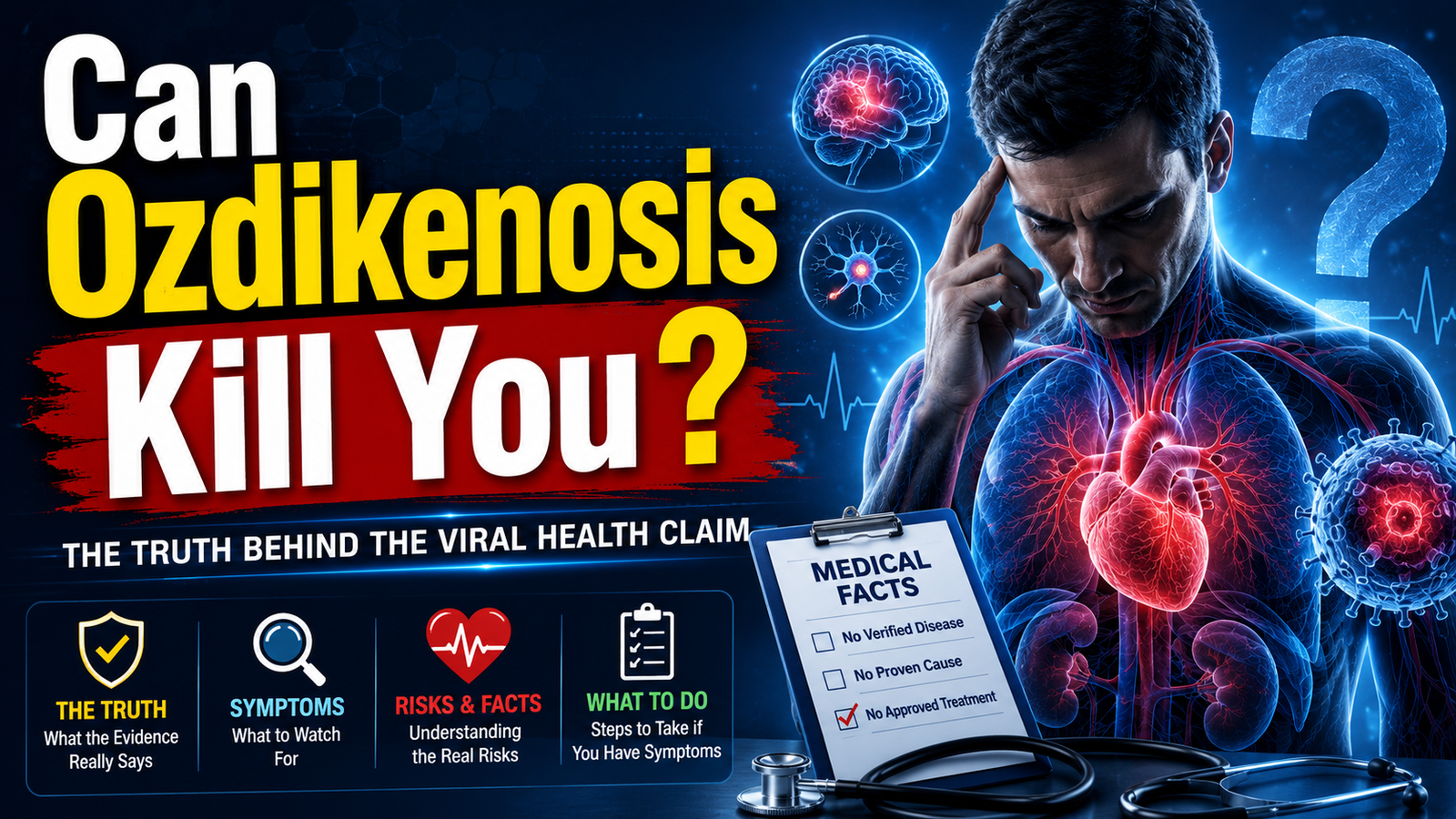
If you searched Ozdikenosis Kill You, you may have found very different answers. Some websites describe ozdikenosis as a serious disease that damages cells, affects the brain, causes organ failure, and may eventually lead to death. Other articles say the term is not a real medical condition at all. That difference is important because health information should be based on evidence, not on how many websites repeat the same claim.
The most important point is this: there is no reliable medical evidence establishing ozdikenosis as a recognized disease with a confirmed cause, disease process, death rate, or treatment plan. The World Health Organization’s ICD-11 is an international system used to record and classify diseases and health conditions, and the WHO explains that inclusion in the classification depends on evidence that a health condition exists.
That means claims about four stages, mitochondrial damage, a special ozdikenosis treatment, or a known path toward multi-organ failure should not be presented as proven medical facts. However, the symptoms mentioned in these articles can be real symptoms of real health problems. This guide explains what is known, what is not known, why the term has become confusing online, and what you should do if you are worried about your health.
Is Ozdikenosis a Real Medical Disease?
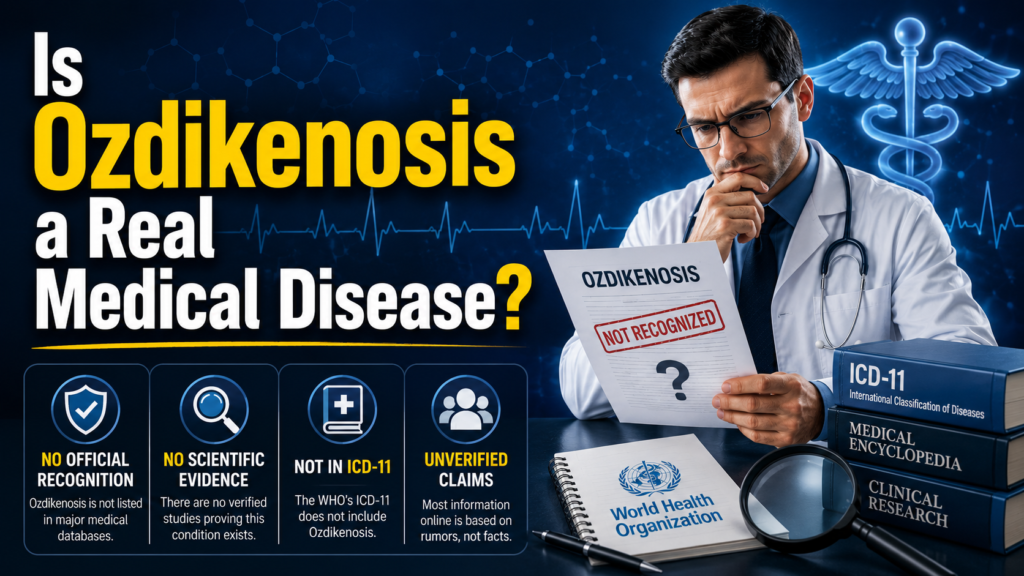
The first question to answer is whether ozdikenosis has been established as a real medical disease. Based on the available evidence, it has not been established as a recognized medical condition. There is no reliable clinical definition that explains exactly what the disease is, what causes it, how doctors diagnose it, or how common it is. That is a major problem with the many articles now using the word. A real disease can be rare and still have medical evidence behind it. Doctors and researchers can describe its symptoms, causes, tests, and treatment even when only a small number of people have it.
The World Health Organization describes ICD-11 as the global standard for recording and reporting diseases, disorders, health conditions, and causes of death. It is used in clinical documentation, research, health statistics, and public health. The WHO also explains that adding a specific category to ICD depends on the usefulness of the category and sufficient evidence that the health condition exists. This does not mean every rare condition must have its own easy-to-find ICD code. However, it does show why a medical term needs more than a blog post to become an accepted diagnosis.
The five competitor articles also show the central problem very clearly: they do not agree on what ozdikenosis actually is. One article says it is not a disease. Another discusses it as a possible cellular or metabolic condition. Another gives it supposed stages and claims that it damages mitochondria. Another connects it with neurological problems and organ failure. These descriptions cannot all be true at the same time. A medical condition should have a stable definition that doctors and researchers can study. When the definition changes from website to website, readers should stop and check the evidence before accepting the claim.
This is also why a scary headline should not be treated as proof. A word can look medical without being a medical diagnosis. The ending “-osis” appears in many genuine medical terms, but that does not make every word ending in “-osis” a real disease. If you encounter ozdikenosis online, the safest conclusion is not that you have discovered a hidden deadly disease. Instead, treat the term as unverified unless a qualified medical source provides evidence supporting it. Your symptoms, if you have any, are still worth taking seriously. The important step is to investigate the symptoms rather than assume that an internet label explains them.
Why Are People Asking Ozdikenosis Kill You Online?
The popularity of the question can be explained without assuming that the disease itself is real. Strange medical-sounding words naturally create curiosity, especially when they are combined with frightening phrases such as “kill you,” “organ failure,” or “fatal disease.” A person may see the term in a social post, video, search suggestion, or another article and then search for more information. The first results may repeat similar claims, making the term look more established than it really is.
This creates a simple information loop. Someone sees an unfamiliar word and searches for it. A website publishes an article because people are searching for the phrase. Another website notices the same search and publishes a similar article. More pages then repeat the same explanation. Eventually, a reader sees the word on many different websites and assumes that the number of pages is proof that the disease is real. But repetition is not the same as medical evidence. Ten websites repeating an unsupported statement do not provide the same evidence as one well-designed clinical study.
The competitor articles show this pattern especially well. Several use almost identical ideas: mysterious symptoms, cellular energy problems, nervous system damage, organ failure, a supposed timeline, and a warning that early diagnosis is important. Yet they do not provide consistent clinical evidence for those claims. One article even gives four supposed stages of ozdikenosis, while another directly says there is no verified disease. That contradiction should be a warning sign for readers.
There is also a human reason why this type of content gets attention. Health uncertainty is uncomfortable. When someone has fatigue, headaches, weakness, breathing problems, or another symptom, they naturally want a simple answer. A strange disease name can seem attractive because it appears to connect many symptoms into one explanation. But real medicine is often more careful. The same symptom can have many possible causes, and doctors may need a history, examination, laboratory tests, imaging, or specialist assessment to find the answer.
This is why the better question is not simply “Why does ozdikenosis kill you?” A more useful question is: “Is there reliable medical evidence that ozdikenosis exists, and if I have symptoms, what real conditions could explain them?” That change in thinking helps separate curiosity from diagnosis. It also prevents a viral search term from becoming a substitute for professional medical care.
What Claims About Ozdikenosis Are Not Proven?
Many online articles make detailed claims about what supposedly happens inside the body. They describe damaged mitochondria, reduced ATP production, immune-system attacks, oxygen loss, nervous system damage, organ failure, and a final stage of multi-organ failure. These ideas use real medical concepts, which makes the articles sound convincing. The problem is that real biological concepts do not automatically prove that they occur in a condition called ozdikenosis.
Mitochondria, for example, are real structures inside cells that help produce energy. Problems involving mitochondria are also real and can occur in genuine mitochondrial diseases. But that does not establish a disease called ozdikenosis. In the same way, ATP is a real molecule involved in cellular energy, inflammation is a real biological process, and organ failure is a real medical emergency. Combining these facts into a story about an unverified disease does not create evidence for that disease.
The same problem appears with the supposed four-stage timeline found in some competitor content. The articles describe a progression from mild fatigue to organ problems, then organ failure, and finally death. But a disease timeline requires actual patient evidence. Researchers need to observe patients, record symptoms, perform tests, follow disease progression, and publish the results. Without that evidence, a neat four-stage chart is only a claim. It should not be presented as an established medical pathway.
The same caution applies to proposed causes. Some articles suggest genetic mutations, environmental toxins, infections, autoimmune problems, or mitochondrial dysfunction. These are all areas of real medical science, but there is no established evidence showing that they are causes of ozdikenosis. Saying “researchers believe” something can also be misleading if there are no identifiable researchers or published studies supporting the statement. Trustworthy health writing should name the evidence instead of creating the appearance of scientific agreement.
This distinction matters because readers may make decisions based on what they read. Someone who believes that an internet disease is caused by mitochondrial damage might search for supplements or special treatments. Someone who believes there is a predictable four-stage progression might panic about normal symptoms. Someone who believes doctors often miss the disease might distrust a medical evaluation. None of those reactions is justified by the evidence available for ozdikenosis.
So, when reading about this term, separate real medical facts from claims attached to the term. Mitochondrial disease is real. Inflammation is real. Sepsis is real. Organ failure is real. But those facts do not prove that ozdikenosis causes them. That is the key difference between learning medicine and accepting an internet story.
What Real Conditions Can Cause Similar Symptoms?
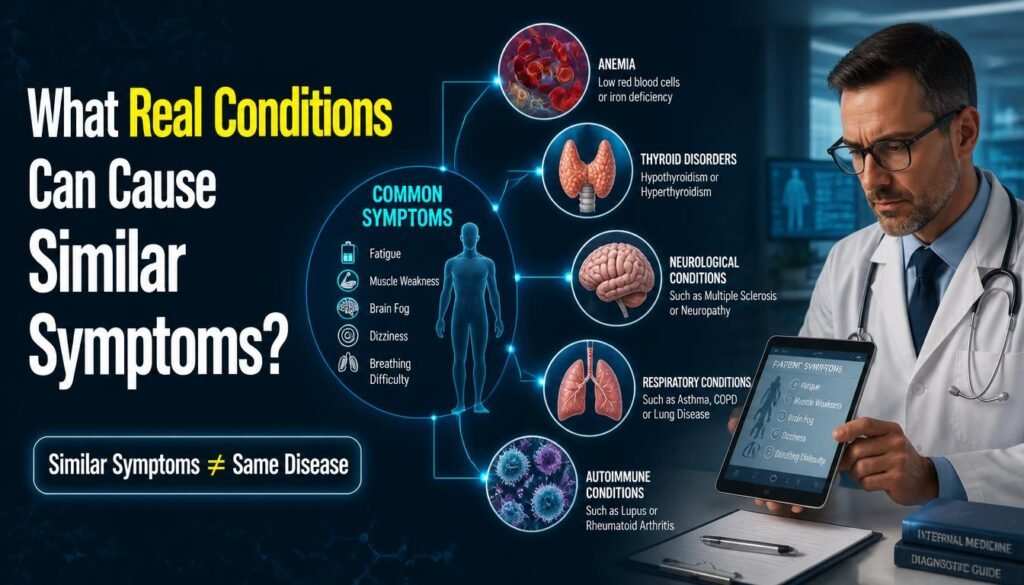
One reason the ozdikenosis story may feel believable is that many of the symptoms mentioned online are common and genuine. Fatigue, difficulty concentrating, muscle aches, weakness, dizziness, and breathing problems can happen for many different reasons. A symptom does not identify one specific disease by itself. This is one of the most important ideas to understand when reading health information online.
For example, ongoing tiredness can be linked to poor sleep, anemia, thyroid problems, infections, medication effects, stress, or many other conditions. Muscle weakness can also have many causes. Brain fog is not a diagnosis by itself. It can describe a person’s experience of having trouble focusing or thinking clearly, but the reason behind it needs to be investigated. This is why medical professionals do not normally diagnose a disease from a list of symptoms copied from a website.
Some real illnesses can also become dangerous when they affect essential body functions. Severe infections can lead to sepsis, which can cause life-threatening problems throughout the body. Serious heart or lung conditions can reduce the body’s ability to move blood or oxygen. Severe problems affecting the brain can interfere with consciousness and other essential functions. These are real medical pathways, but they should not be confused with an unverified ozdikenosis mechanism.
This distinction is especially important because some competitor articles connect almost every serious symptom to the keyword. One article lists breathing problems, memory loss, seizures, heart problems, kidney problems, and multi-organ failure as stages of ozdikenosis. That makes the term sound like an established diagnosis, even though the same article provides no reliable clinical evidence. A better approach is to explain that these symptoms can occur in many real conditions and should be assessed based on the person’s actual situation.
Imagine a student who has been tired for several weeks and reads that fatigue is the first stage of ozdikenosis. The student may become frightened and start looking for more articles. But fatigue alone does not establish a disease. A doctor may instead ask about sleep, diet, stress, recent illness, medications, and other symptoms. Depending on the situation, the doctor may recommend an examination or tests. The real value of medical care is that it looks at the whole person rather than forcing every symptom into one internet label.
The same principle works for more serious symptoms. If someone has persistent or severe breathing difficulty, chest pain, confusion, fainting, or another worrying change, the correct response is medical evaluation rather than searching for a rare internet term. The CDC advises seeking emergency medical care for symptoms such as trouble breathing, persistent chest pain or pressure, confusion or unusual behavior, or inability to wake or stay awake.
How Can You Fact-Check a Viral Disease Claim?
You do not need to be a doctor to recognize warning signs in health content. The first step is to ask whether the article clearly separates evidence from speculation. A trustworthy health article should explain where its information comes from. Look for named medical organizations, peer-reviewed research, clinical guidelines, or recognized disease databases. Be careful when an article repeatedly says “researchers believe” or “studies show” without telling you which researchers or studies are being discussed.
Next, check whether different sources agree on the basic definition. A real disease can have complex symptoms and different forms, but its basic identity should not change completely from one page to another. If one article says a condition is a metabolic disorder, another says it is a genetic growth disorder, and another says it is an invented internet term, that disagreement is important evidence that you should investigate further.
Official disease classification systems can also be useful. The WHO describes ICD-11 as an international standard for recording and reporting diseases and other health conditions. The system is designed to support clinical documentation, research, health statistics, and other health-related work. A missing classification entry does not automatically prove that a health idea is false, especially because medicine contains emerging and rare conditions. However, when a supposed disease also lacks reliable studies, diagnostic criteria, clinical guidance, and consistent medical definitions, the lack of recognition becomes much more meaningful.
Another useful check is to look at the quality of the evidence. Is the article describing an actual study, or simply repeating another website? Does it give the name of a medical organization? Does it provide a clear date and explain what is known and unknown? Does it admit uncertainty? Good health information does not need to sound dramatic. In fact, careful language is often a positive sign. Statements such as “there is not enough evidence to confirm this” are much more trustworthy than confident claims with no supporting source.
Finally, ask whether the article is trying to make you afraid. Headlines about deadly diseases can attract attention, but fear should never be used as a substitute for evidence. A page that promises a hidden truth, secret cure, shocking timeline, or guaranteed outcome deserves extra caution. This is especially true when it recommends products, supplements, or treatments for a condition that has not been medically established.
The simplest rule is this: do not diagnose yourself from a viral article. Use online information to learn questions to ask, then take health concerns to a qualified healthcare professional. If a term cannot be verified but your symptoms are real, the symptoms still deserve attention.
What Should You Do If You Have Symptoms?
If you searched Ozdikenosis Kill You because you are experiencing symptoms, the most useful thing you can do is focus on what your body is actually telling you. Write down what you feel, when it started, whether it is getting better or worse, and whether anything seems to trigger it. This gives a healthcare professional useful information without requiring you to decide what disease is responsible.
It can also help to avoid jumping from one symptom to one diagnosis. For example, tiredness does not automatically mean a serious disease, and muscle pain does not automatically mean a mitochondrial problem. At the same time, symptoms that continue, become severe, or interfere with normal activities should not simply be ignored. A healthcare professional can decide whether you need an examination, blood tests, imaging, or another type of evaluation.
There are also situations where waiting for an online answer is not appropriate. The CDC identifies trouble breathing, chest pain or pressure that does not go away, confusion or unusual behavior, and difficulty staying awake among symptoms that can require emergency medical care. The exact warning signs can vary by illness and age, so serious or rapidly worsening symptoms should be assessed by a medical professional rather than explained through an internet search.
It is also important not to buy into unsupported treatments. If a website claims to have a special ozdikenosis cure, supplement, detox, protocol, or diet, ask what evidence supports it. If there is no recognized diagnosis and no clinical research showing that the treatment works for that diagnosis, be very cautious. Trying random treatments can distract from finding the real reason for symptoms.
A simple example makes this clear. Suppose someone has ongoing tiredness and trouble concentrating. An online article might tell them these are the first signs of a fictional or unverified disease. A better approach is to record the symptoms and discuss them with a doctor. The doctor may consider sleep, nutrition, stress, anemia, thyroid problems, infection, medication effects, or other possibilities. The goal is not to find the most frightening explanation. The goal is to find the most evidence-based explanation.
Your symptoms can be real even when the label you found online is not. That is an important message to remember. You do not need to prove that you have ozdikenosis before asking for help. You simply need to explain what you are experiencing clearly and honestly.
FAQs About Ozdikenosis
Q: Can ozdikenosis kill you?
A: There is no reliable medical evidence establishing ozdikenosis as a recognized disease, so there is no verified death rate or proven mechanism showing that it kills people. Claims about organ failure or a fixed fatal progression are not supported by established clinical evidence.
Q: Is ozdikenosis a real disease?
A: It is not currently established as a recognized medical condition. The term appears in online articles, but those articles do not provide consistent medical definitions or reliable clinical evidence. WHO’s ICD-11 is an important international disease-classification system, although absence from a classification alone should not be treated as the only test of whether a condition is real.
Q: What causes ozdikenosis?
A: No confirmed cause has been established. Online claims about mitochondrial damage, genetics, toxins, inflammation, or infections should not be treated as proven causes of ozdikenosis.
Q: Does ozdikenosis have four stages?
A: There is no verified medical staging system for ozdikenosis. Some websites describe four stages, but they do not provide reliable clinical studies showing that patients progress through those stages.
Q: What if I have symptoms linked to ozdikenosis?
A: Focus on the symptoms rather than the internet label. Write down when they began and how they are changing, then speak with a qualified healthcare professional. Many common symptoms can have several different causes.
Q: When should I seek urgent medical help?
A: Seek urgent medical care for serious symptoms such as trouble breathing, persistent chest pain or pressure, confusion, or difficulty staying awake. The CDC recommends emergency evaluation for these warning signs in the relevant situations.
Conclusion: What the Ozdikenosis Question Really Means
The question Ozdikenosis Kill You? sounds frightening because many online pages connect the term with cell damage, neurological problems, organ failure, and death. But those claims should not be confused with established medical knowledge. At present, there is no reliable evidence showing that ozdikenosis is a recognized disease with a confirmed cause, diagnostic test, official treatment, or proven fatal pathway. The biggest lesson from the search results is that repetition does not turn an unsupported claim into medical fact.
If you are worried because you have real symptoms, do not let an unfamiliar internet term become your diagnosis. Symptoms such as fatigue, weakness, breathing problems, confusion, or pain can have many causes, and some may need medical attention. Use reliable health information to understand the possibilities, but let a qualified healthcare professional evaluate your individual situation. The safest takeaway is simple: question the label, take real symptoms seriously, and choose evidence over fear.