Table of Contents
Introduction
If you have searched for adswynk com, you are probably trying to learn what it is, how it works, and whether it can help you earn money online or promote your business. Many beginners, bloggers, and affiliate marketers are looking for advertising platforms that are easy to understand and simple to use. However, it can be difficult to find clear information, especially when a platform is new or not widely discussed.
Online advertising has become one of the most effective ways to reach the right audience and grow a website or business. Whether you want to increase website traffic, improve brand awareness, or generate more leads, choosing the right advertising platform is an important first step.
This guide explains Adswynk.com in simple language. You will learn how online advertising platforms generally work, the features you should expect, how publishers and advertisers can benefit, and practical tips for getting better results. By the end of this article, you will have a better understanding of whether Adswynk.com matches your goals.
What Is Adswynk com?
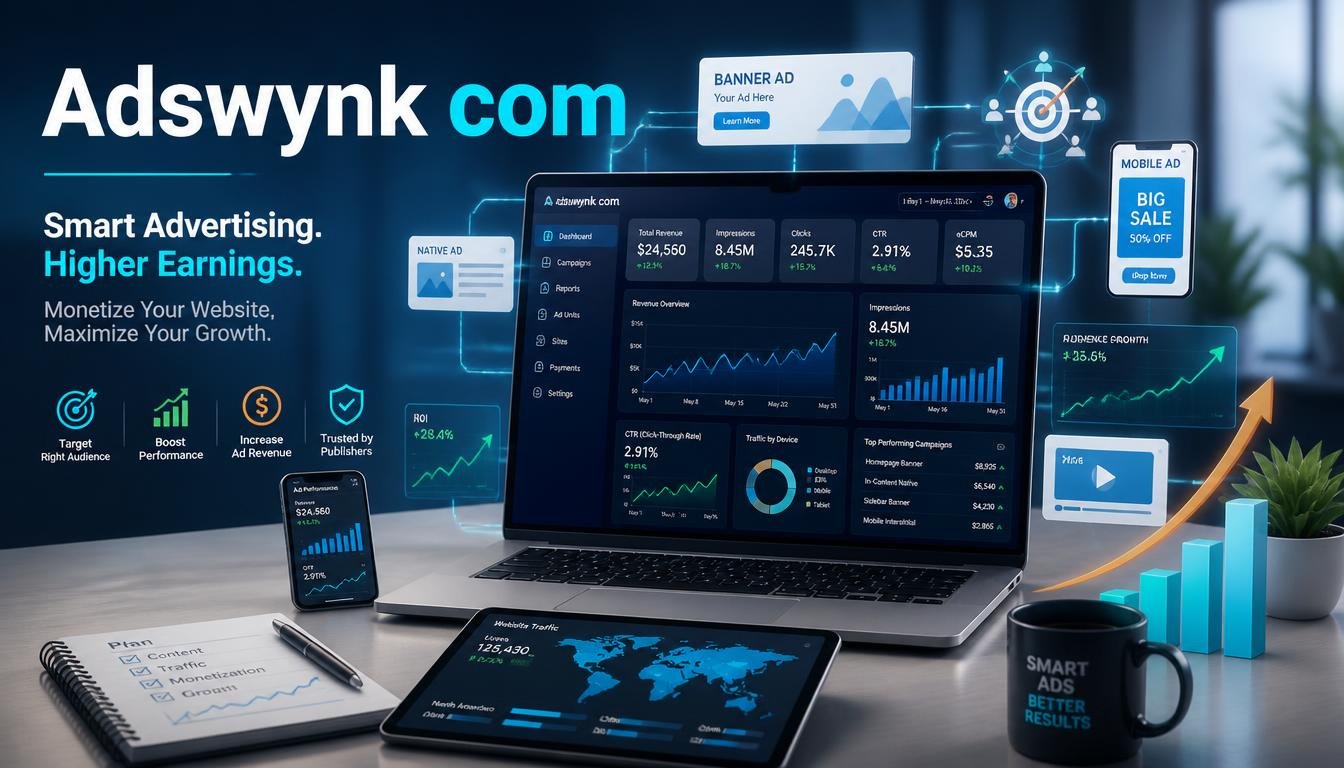
Adswynk.com appears to be an online advertising platform designed to connect advertisers who want to promote their products or services with publishers who have websites or online audiences. Like many digital advertising networks, its goal is to help businesses reach potential customers while giving website owners opportunities to monetize their content through advertising.
Although every advertising platform has its own features and requirements, the basic idea is similar. Advertisers create campaigns, choose a target audience, and pay for advertising. Publishers display advertisements on their websites or digital properties and may earn revenue based on campaign performance or other payment models.
Instead of thinking of an advertising network as just a place to show ads, it is better to see it as a system that brings together two groups:
- Businesses looking for customers
- Website owners looking to earn advertising income
When both sides benefit, the platform becomes useful for everyone involved.
Who Can Use Adswynk?
One of the biggest advantages of modern advertising platforms is that they are useful for different types of users.
Bloggers
Bloggers often rely on advertising to generate income from their websites. As their traffic grows, they may look for additional ad networks that match their audience and content.
For example, a travel blogger writing about budget vacations may want advertisements that are relevant to travelers instead of random products. Better audience targeting often leads to better engagement and improved click-through rates.
Affiliate Marketers
Affiliate marketers focus on promoting products through content, reviews, comparison articles, and landing pages. Advertising can help bring additional visitors to these pages, increasing opportunities for conversions.
Instead of depending only on search engine traffic, affiliate marketers may combine SEO with paid advertising and other digital marketing strategies to reach more potential buyers.
Small Businesses
Small businesses often have limited marketing budgets. An advertising platform can help them reach local or national audiences without spending as much as traditional advertising methods.
For example, a local fitness center may run online campaigns to attract new members in nearby areas while tracking campaign performance through analytics.
Website Owners and Publishers
Anyone who owns a website with regular visitors may be interested in website monetization. Displaying advertisements can become an additional source of income alongside affiliate marketing, sponsored content, or selling digital products.
The key is maintaining a good balance between advertising and user experience. Too many ads can reduce visitor satisfaction and increase bounce rates.
What Problems Does It Solve?
Many beginners enter online marketing with the same questions:
- How do I earn money from my website?
- How can I attract more visitors?
- How do businesses advertise online?
- Which advertising platform should I choose?
An advertising platform aims to solve these challenges by providing tools that make campaign management easier and more organized.
For publishers, the biggest benefit is the opportunity to monetize existing website traffic. Instead of relying on only one income source, they can diversify their earnings through advertising.
For advertisers, the platform provides a way to reach people who are more likely to be interested in their products or services. Better audience targeting often leads to improved customer acquisition and stronger return on investment (ROI).
Why Online Advertising Matters Today
Digital advertising has become one of the fastest-growing areas of online business because people spend more time on websites, social media, and mobile devices than ever before.
Compared to traditional advertising methods such as newspapers or billboards, online advertising offers several important advantages:
- Better audience targeting
- Real-time campaign management
- Flexible advertising budgets
- Detailed performance reports
- Easier optimization based on data
For example, instead of showing an advertisement to everyone in a city, an advertiser can choose to display it only to people who have shown interest in fitness, technology, travel, or another specific topic.
This level of targeting helps businesses spend their marketing budget more efficiently.
Key Terms Beginners Should Know
Before learning how Adswynk.com works, it helps to understand a few common advertising terms.
Impressions
An impression is counted each time an advertisement is displayed to a visitor, whether they click on it or not.
Click-Through Rate (CTR)
CTR measures how many people click an advertisement after seeing it. A higher CTR usually suggests that the advertisement is relevant to its audience.
Conversion Rate
A conversion happens when a visitor completes a desired action after clicking an advertisement. This action could include:
- Buying a product
- Filling out a contact form
- Downloading an ebook
- Signing up for a newsletter
Improving conversion rates is often more valuable than simply increasing traffic.
Analytics
Advertising analytics help advertisers and publishers understand campaign performance by tracking important metrics such as:
- Website traffic
- Clicks
- Impressions
- Conversion rates
- Engagement metrics
- Return on investment
Using analytics allows marketers to make better decisions instead of relying on guesswork.
How Adswynk com Works
Although each advertising platform has its own dashboard and tools, most follow a similar process. Understanding this workflow makes it easier to use any online advertising network effectively.
At a basic level, the platform connects advertisers who want exposure with publishers who have audiences to reach. The platform manages campaign delivery, tracks performance, and provides reporting so both sides can measure results.
Rather than simply placing ads everywhere, successful campaigns depend on choosing the right audience, creating relevant advertisements, and monitoring performance over time.
For Publishers
Publishers are website owners, bloggers, or content creators who allow advertisements to appear on their websites.
A typical publisher workflow includes the following steps:
Step 1: Join the Platform
The publisher creates an account and provides information about their website. Some advertising networks review websites before approving them to ensure they meet quality standards.
Before applying, check that your website:
- Has original content
- Loads quickly
- Is easy to navigate
- Receives consistent traffic
- Offers a good user experience
Even if traffic is still growing, quality content often matters more than simply having a large number of visitors.
Step 2: Add Advertisements
Once approved, publishers usually receive ad code or access to tools that allow advertisements to appear on selected pages.
Common placement areas include:
- Website header
- Sidebar
- Within articles
- Footer
- Between content sections
Choosing ad placement carefully helps improve visibility without making pages feel crowded.
Step 3: Monitor Performance
After advertisements are live, publishers should regularly review analytics to understand how visitors interact with them.
Useful metrics include:
- Impressions
- Click-through rate (CTR)
- Revenue
- Visitor engagement
- Traffic sources
Rather than leaving advertisements unchanged, successful publishers continually test different layouts and placements to improve results.
For Advertisers
Advertisers use the platform to promote products, services, or brands to a specific audience.
The typical process looks like this:
Step 1: Create a Campaign
Advertisers define their goals before launching a campaign. Common goals include:
- Increasing website traffic
- Generating leads
- Growing brand awareness
- Driving product sales
- Promoting a new service
Having a clear objective makes it easier to measure success later.
Step 2: Choose the Target Audience
Audience targeting is one of the biggest advantages of digital advertising.
Instead of advertising to everyone, businesses can focus on users based on factors such as:
- Interests
- Location
- Device type
- Demographics
- Online behavior
Reaching the right audience often produces better engagement than reaching a larger but less relevant audience.
Step 3: Launch and Track Campaigns
Once the campaign is active, advertisers monitor its performance using reporting and analytics tools.
Key performance indicators (KPIs) commonly include:
- Impressions
- Clicks
- Click-through rate
- Conversion rate
- Cost per click (CPC)
- Cost per impression (CPM)
- Return on investment (ROI)
These metrics help identify which campaigns perform well and which need improvement.
Beginner Mistakes to Avoid
Whether you’re a publisher or an advertiser, avoiding a few common mistakes can save time and money.
- Expecting instant results instead of allowing time for optimization.
- Ignoring analytics and making decisions based on assumptions.
- Targeting audiences that are too broad.
- Placing too many ads on a webpage, creating a poor user experience.
- Failing to test different headlines, creatives, or ad placements.
- Not improving landing pages after attracting visitors.
A successful advertising strategy is usually built through continuous testing, careful analysis, and gradual improvements rather than quick wins.
Key Features and Advertising Options
Choosing an advertising platform is about more than simply displaying ads. The right platform should help you reach your marketing goals, improve user engagement, and provide useful data for making better decisions. Whether you are a publisher earning ad revenue or an advertiser promoting products, understanding the available features can help you get better results.
Below are some of the most important features you should look for when evaluating Adswynk.com or any other advertising network.
Available Ad Formats
Different visitors respond to different types of advertisements. Using the right format can improve visibility without negatively affecting the user experience.
Banner Ads
Banner ads are one of the oldest and most common forms of online advertising. They usually appear at the top, bottom, or sides of a webpage.
Banner ads work well for:
- Brand awareness
- Product promotions
- Seasonal campaigns
- New product launches
Example:
A travel blog could display a banner promoting discounted hotel bookings during the holiday season.
Display Ads
Display advertising combines images, graphics, and text to attract attention. These ads are commonly shown across websites within an advertising network.
Benefits include:
- Strong visual appeal
- Better product visibility
- Flexible sizes
- Easy campaign management
Display ads are especially useful for businesses introducing a new product or service.
Native Advertising
Native ads blend naturally with website content instead of looking like traditional advertisements.
Because they match the style of the page, visitors often find them less distracting.
Native advertising works well for:
- Blog recommendations
- Product guides
- Sponsored articles
- Educational content
Example:
A technology blog could recommend a software tool through a sponsored article that provides genuine value to readers.
Mobile Ads
With millions of users browsing on smartphones every day, mobile advertising has become essential.
Good mobile ads should:
- Load quickly
- Fit smaller screens
- Avoid blocking important content
- Be easy to click without causing frustration
A mobile-friendly website also improves user experience and supports SEO.
Video Ads
Video advertising continues to grow because it quickly captures attention.
Businesses often use video ads for:
- Product demonstrations
- Brand storytelling
- Tutorials
- Customer testimonials
Short, informative videos usually perform better than long promotional content.
Sponsored Content
Sponsored content focuses on educating readers while promoting a product or service naturally.
Instead of directly selling, it provides useful information first.
Examples include:
- Product reviews
- Buying guides
- Industry case studies
- Educational articles
This approach often builds more trust than aggressive advertising.
Performance and Optimization Tools
Good advertising is based on data, not guesswork. Useful reporting tools help advertisers and publishers understand what is working and what needs improvement.
Analytics Dashboard
Most advertising platforms provide a dashboard where users can monitor campaign performance in one place.
Common metrics include:
- Website traffic
- Impressions
- Clicks
- Click-through rate (CTR)
- Conversion rate
- Revenue
- Engagement metrics
Checking these reports regularly helps identify successful campaigns.
Reporting
Detailed reports help answer questions such as:
- Which ads receive the most clicks?
- Which pages generate the highest ad revenue?
- Which campaigns have the best ROI?
- Which audience segments perform better?
Instead of making random changes, marketers can improve campaigns based on real data.
Tracking Pixels and Event Tracking
Tracking pixels and event tracking allow advertisers to understand visitor behavior after someone clicks an advertisement.
Examples include tracking:
- Product purchases
- Newsletter sign-ups
- Form submissions
- Button clicks
- Page views
These insights help improve future advertising campaigns.
Optimization Tools
Optimization is an ongoing process rather than a one-time task.
Useful optimization techniques include:
- Testing different headlines
- Changing ad placement
- Improving landing pages
- Updating call-to-action buttons
- Comparing different ad creatives
Small improvements made consistently can produce better long-term results than making major changes all at once.
How to Choose the Right Ad Format
Not every advertisement works equally well on every website.
Here is a simple guide.
| Goal | Recommended Ad Format |
|---|---|
| Increase brand awareness | Banner ads |
| Generate product sales | Display ads |
| Build trust | Sponsored content |
| Improve engagement | Native advertising |
| Promote tutorials | Video ads |
| Reach mobile users | Mobile ads |
Choosing an ad format should always match your audience rather than following trends.
How Bloggers and Affiliate Marketers Can Get Better Results
Simply placing advertisements on a website does not guarantee success. The highest-performing websites focus on delivering useful content first while continuously improving their advertising strategy.
Whether you run a personal blog or an affiliate website, these practical tips can help improve both user experience and advertising performance.
Improve Clicks and Conversions
Many beginners focus only on increasing traffic. However, getting the right visitors is usually more important than attracting a large number of random users.
Write Helpful Content
High-quality content naturally attracts more visitors and keeps them on your website longer.
Examples include:
- Step-by-step tutorials
- Honest product reviews
- Comparison articles
- Buying guides
- Frequently asked questions
Helpful content often generates more trust, leading to higher conversion rates.
Improve Ad Placement
Advertisements should be easy to notice without interrupting the reading experience.
Good locations include:
- Near article introductions
- Between long sections
- After helpful content
- Sidebar areas (where appropriate)
Avoid placing too many advertisements above the main content because this can reduce user satisfaction.
Understand Your Target Audience
Successful advertising starts with understanding who your readers are.
Ask questions such as:
- What problems are they trying to solve?
- What products interest them?
- What type of content do they read most?
For example:
A personal finance blog may attract readers looking for budgeting tools, while a fitness website may perform better with health-related advertising.
Showing relevant advertisements usually produces higher engagement.
Optimize Every Campaign
Digital marketing is rarely perfect the first time. Successful marketers regularly test different ideas and improve campaigns using performance data.
Test Different Headlines
A small headline change can sometimes increase click-through rates significantly.
For example:
Instead of:
Learn About Budgeting
Try:
5 Simple Budgeting Tips That Save Money Every Month
Testing multiple versions helps identify what readers respond to best.
Improve Landing Pages
Sending visitors to a poor landing page wastes advertising money.
A good landing page should:
- Load quickly
- Have a clear headline
- Explain benefits clearly
- Include one main call to action
- Work well on mobile devices
Removing unnecessary distractions often improves conversion rates.
Track Return on Investment
Return on investment (ROI) helps determine whether advertising spending is producing positive results.
Instead of asking:
“Did people click my ad?”
Ask:
“Did the advertisement help achieve my business goal?”
A campaign with fewer clicks but more sales may perform better than one with thousands of visitors and very few conversions.
Perform Regular Split Testing
Split testing (A/B testing) compares two versions of an advertisement or webpage.
You might test:
- Headlines
- Images
- Call-to-action buttons
- Ad sizes
- Landing page layouts
Changing only one element at a time makes it easier to identify what improves performance.
Avoid Common Beginner Mistakes
Many new bloggers and affiliate marketers make similar mistakes. Avoiding them can save both time and money.
Showing Too Many Ads
Too many advertisements can make a website feel crowded and reduce visitor trust.
Focus on quality instead of quantity.
Ignoring Analytics
Without analytics, it is impossible to know which campaigns are successful.
Review performance regularly and make decisions based on data rather than assumptions.
Targeting Everyone
Trying to reach everyone often means reaching no one effectively.
Audience segmentation helps advertisers create more relevant campaigns for specific groups of users.
Forgetting SEO
Advertising works best alongside strong search engine optimization.
Good SEO helps generate consistent organic traffic, while advertising can provide additional exposure and faster results.
Some useful SEO practices include:
- Keyword research
- Optimized page titles
- Internal linking
- Fast page speed
- Mobile-friendly design
- XML sitemaps
Combining SEO with online advertising creates a stronger long-term digital marketing strategy.
Focus on User Experience
A successful website always puts visitors first.
Before adding more advertisements, ask yourself:
- Is the page easy to read?
- Does it load quickly?
- Are the advertisements relevant?
- Would I enjoy visiting this page myself?
When users have a positive experience, they are more likely to stay longer, return in the future, and engage with your content.
Pros, Cons, and Alternatives
Like any online advertising platform, Adswynk.com may offer advantages for some users while being less suitable for others. The best choice depends on your website, marketing goals, budget, and audience. Instead of looking for a “perfect” advertising network, focus on finding one that fits your needs and helps you measure results.
Pros
Easy for Beginners to Understand
Many people starting in digital marketing feel overwhelmed by technical terms and complex dashboards. A platform with a simple interface makes it easier to launch campaigns, monitor performance, and learn online advertising step by step.
If you are a new blogger or affiliate marketer, starting with basic campaigns allows you to gain experience before investing more time or money.
Multiple Advertising Opportunities
A platform that supports different ad formats gives users more flexibility. Depending on your goals, you may choose:
- Banner ads
- Display ads
- Native advertising
- Mobile ads
- Video ads
- Sponsored content
Having several options makes it easier to match advertisements with different types of content.
Campaign Performance Tracking
Good reporting tools help you understand what is working and what needs improvement.
For example, if one advertisement receives many impressions but very few clicks, you may need to:
- Improve the headline
- Change the image
- Adjust audience targeting
- Test another placement
Using analytics regularly helps improve campaign performance over time.
Better Audience Targeting
Showing advertisements to the right people is often more effective than showing them to everyone.
For example:
A website about photography should display camera equipment or editing software instead of unrelated products.
Relevant advertisements usually receive higher engagement and better conversion rates.
Supports Long-Term Growth
Advertising should not only focus on immediate sales.
It can also help:
- Build brand awareness
- Increase customer engagement
- Generate qualified leads
- Grow website traffic
- Support long-term business growth
Combining advertising with quality content creates a stronger online presence.
Cons
No advertising platform is perfect, and it’s important to understand the possible challenges before getting started.
Results Depend on Traffic Quality
Simply having thousands of visitors does not guarantee success.
If visitors are not interested in your content or products, advertising performance will likely be poor.
Quality traffic is usually more valuable than high traffic numbers.
Requires Continuous Optimization
Successful campaigns are rarely “set and forget.”
You should regularly:
- Review analytics
- Test different creatives
- Update landing pages
- Improve targeting
- Adjust budgets
Without optimization, campaign performance may decline over time.
Learning Takes Time
Even beginner-friendly advertising platforms require some learning.
Understanding terms such as:
- CPC
- CPM
- CTR
- Conversion rate
- ROI
will help you make better decisions.
Fortunately, these concepts become much easier with practice.
Costs Can Add Up
For advertisers, poor campaign planning can increase advertising costs without producing meaningful results.
Always begin with a small budget, monitor performance, and scale only after finding campaigns that work well.
Popular Alternatives
Before choosing any advertising platform, it is worth comparing several options.
Google Ads
Google Ads is one of the largest online advertising platforms.
Best for:
- Search advertising
- Display advertising
- Shopping campaigns
- Local businesses
Strengths:
- Large audience reach
- Advanced targeting
- Detailed analytics
Considerations:
- Can be competitive
- Requires careful budget management
Facebook Ads
Facebook Ads (also used across Instagram) are popular for audience targeting based on interests and demographics.
Best for:
- Brand awareness
- Ecommerce
- Local promotions
- Social media marketing
Strengths:
- Excellent audience segmentation
- Strong visual advertising
- Flexible campaign objectives
Other Advertising Networks
Depending on your niche, other advertising networks may also be worth exploring.
Some specialize in:
- Native advertising
- Video advertising
- Mobile advertising
- Programmatic advertising
- Affiliate-focused campaigns
Rather than relying on one platform, experienced marketers often compare multiple networks to find the best fit.
Quick Comparison
| Feature | Adswynk.com* | Google Ads | Facebook Ads |
|---|---|---|---|
| Beginner Friendly | May vary | Moderate | Easy to Moderate |
| Audience Targeting | Available | Advanced | Advanced |
| Analytics | Available | Excellent | Excellent |
| Ad Formats | Multiple | Multiple | Multiple |
| Best For | Publishers & Advertisers | Search & Display | Social Media Campaigns |
*Features and availability may change over time. Always review the platform’s latest documentation before making business decisions.
Is Adswynk com Worth Trying?
The answer depends on your goals.
If you are looking for another way to advertise your business or monetize a website, it may be worth researching and testing the platform.
However, no advertising platform can guarantee success on its own.
Success depends on factors such as:
- Content quality
- Audience targeting
- Website traffic
- Landing page quality
- Campaign optimization
- Budget management
Think of advertising as one part of a complete digital marketing strategy rather than a standalone solution.
Best for Beginners
If you are new to online advertising:
✔ Start with one campaign.
✔ Learn how analytics work.
✔ Monitor your click-through rate.
✔ Test different advertisements.
✔ Improve your content regularly.
Small improvements made consistently usually produce better long-term results than trying to grow too quickly.
Best for Bloggers
Bloggers may benefit if they:
- Publish helpful content regularly
- Build consistent website traffic
- Focus on reader experience
- Combine advertising with SEO
A blog that answers readers’ questions naturally attracts visitors who are more likely to engage with relevant advertisements.
Best for Affiliate Marketers
Affiliate marketers can improve results by combining advertising with:
- Keyword research
- High-quality landing pages
- Honest product reviews
- Comparison articles
- Email marketing
- Retargeting campaigns
Advertising should support your overall marketing strategy rather than replace quality content.
Quick Decision Checklist
Before using any advertising platform, ask yourself:
- Does my website provide useful content?
- Do I understand my target audience?
- Can I monitor campaign performance?
- Am I prepared to test different strategies?
- Do I have realistic expectations?
If you answered “Yes” to most of these questions, you are in a better position to succeed.
Frequently Asked Questions
What is Adswynk com?
Adswynk.com is an online advertising platform that aims to connect advertisers with publishers, helping businesses promote their products while allowing website owners to monetize their traffic.
Is Adswynk com suitable for beginners?
Yes. Beginners can learn the basics of online advertising by starting with small campaigns, tracking performance, and improving their strategy over time.
How can bloggers benefit from Adswynk com?
Bloggers can use advertising platforms to monetize their websites, increase ad revenue, and improve audience engagement by displaying relevant advertisements.
What advertising formats are commonly available?
Most advertising platforms offer banner ads, display ads, native advertising, mobile ads, video ads, and sponsored content to reach different audiences.
How can I improve my advertising results?
Improve results by creating valuable content, targeting the right audience, optimizing ad placement, testing campaigns regularly, and reviewing analytics to make informed decisions.
Conclusion
Understanding adswynk com starts with understanding how online advertising works. Whether you are a blogger looking to monetize your website, an affiliate marketer trying to increase conversions, or a business owner hoping to reach more customers, the right advertising strategy is built on planning, testing, and continuous improvement.
Instead of chasing quick results, focus on creating valuable content, understanding your audience, and using analytics to make informed decisions. Advertising performs best when it supports a broader digital marketing strategy that includes SEO, user experience, and consistent optimization.
If you decide to explore Adswynk.com, start with realistic expectations. Test small campaigns, review your results, and improve gradually. Over time, these small improvements can lead to better engagement, stronger campaign performance, and more sustainable business growth.