Table of Contents
If you own or are thinking about buying a Cadillac LYRIQ, you may have noticed that the SUV offers different driving modes. That can lead to a simple but important question: do the driving modes in Cadillac LYRIQ offer different ranges or battery usages?
The short answer is yes, the selected driving mode can affect how much energy the LYRIQ uses, but it does not change the physical capacity of the battery. A mode can change how the vehicle responds to the accelerator, steering, braking, and other systems. The way you drive in that mode then affects energy consumption and, as a result, your real-world range.
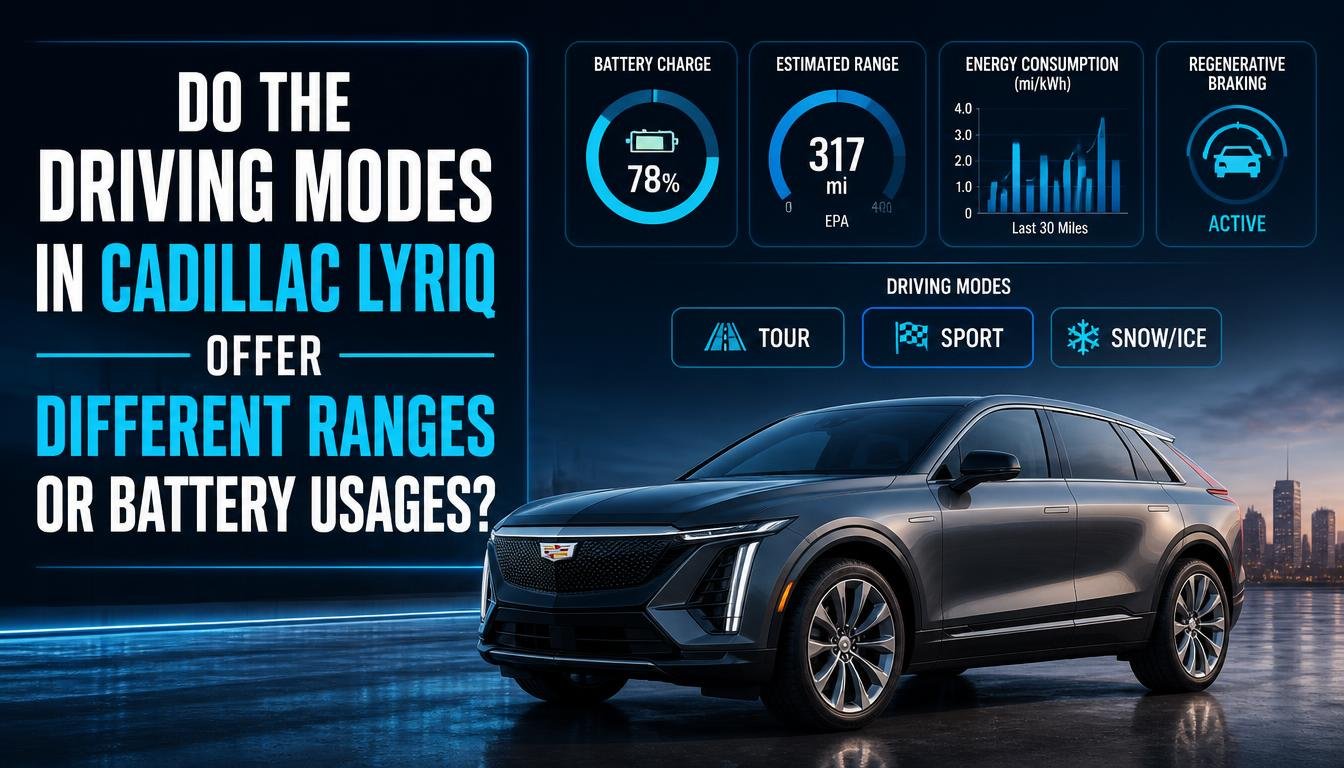
Cadillac currently describes LYRIQ modes such as Tour, Snow/Ice, Sport, and My Mode, although the exact modes and equipment can vary by model and configuration. Tour is designed around smooth everyday driving, Snow/Ice is intended to help prevent wheel spin on slippery surfaces, Sport provides a more immediate driving response, and My Mode allows certain driving characteristics to be personalized.
However, it would be misleading to say that one mode always gives a fixed number of extra miles. Your LYRIQ’s range also depends on speed, acceleration, temperature, terrain, tire condition, climate control, vehicle load, battery temperature, and other conditions. Cadillac itself states that actual range can vary because of factors such as temperature, terrain, battery age, loading, use, and maintenance.
So, rather than asking which mode magically gives the longest range, it is better to ask: which mode helps me drive most efficiently for the situation I am in?
Do the Driving Modes in Cadillac LYRIQ Offer Different Ranges or Battery Usages?
Driving modes can affect battery usage, but they do not give the battery a different amount of stored energy.
Think of the LYRIQ battery as a tank of available electrical energy. Changing the driving mode does not make that tank larger or smaller. Instead, the selected mode can change how the vehicle behaves and how easily the driver asks for power.
For example, imagine two LYRIQ drivers start with the same state of charge. One driver uses a normal everyday mode and accelerates gently. The other frequently makes strong accelerations and drives at higher speeds while using a more performance-focused setting. Even though both vehicles started with the same battery charge, their energy consumption can be very different.
That means the difference you see is mainly about energy consumption, not battery capacity.
Cadillac describes the Driver Mode Control system as a way to tailor vehicle performance according to road conditions or driving preferences. On the current LYRIQ, Tour is intended for everyday driving, Sport is designed for a more immediate and connected driving feel, Snow/Ice is intended for slippery conditions, and My Mode offers personalization.
Driving Mode Changes Behavior, Not Battery Capacity
This is the most important distinction to understand.
There are four different ideas that are easy to mix together:
- Battery capacity: How much energy the battery can store.
- Battery usage: How much of that stored energy the vehicle consumes.
- Energy efficiency: How much energy the LYRIQ uses to travel a given distance.
- Estimated range: How far the vehicle expects to travel based on available energy and driving conditions.
Changing from Tour to Sport does not suddenly give the LYRIQ a smaller battery. Instead, Sport can make the vehicle feel more responsive. If that encourages stronger acceleration or faster driving, the vehicle can use more energy.
The opposite can also happen. A driver could select a performance-oriented mode but drive gently. In that case, the real difference in energy consumption may be much smaller than someone might expect.
This is why there is no reliable rule saying that a particular mode always reduces range by a specific percentage.
How Cadillac LYRIQ Driving Modes Can Affect Energy Consumption
The best way to understand driving modes is to think about what they encourage the vehicle and driver to do.
Tour is designed for everyday driving and a smooth experience. Sport is calibrated for a more immediate response and a stronger feeling of connection with the road. Snow/Ice changes the vehicle’s response to help control wheel slip on slippery surfaces. My Mode can let the driver customize certain characteristics.
These differences can influence energy consumption because electric motors can use considerably more power when the driver asks for strong acceleration.
An EV is particularly responsive because electric motors can deliver torque quickly. That instant response is one of the enjoyable parts of driving an EV. However, repeatedly asking for high power can increase electricity use.
For everyday driving, a smooth approach usually makes more sense if your goal is to maximize range.
For example, imagine leaving a traffic light. If you accelerate smoothly and reach your target speed without unnecessary bursts of power, the vehicle can use energy more efficiently than if you repeatedly accelerate hard and then brake heavily.
The same principle applies on highways. Maintaining a steady speed is generally more predictable for energy consumption than repeatedly changing speed.
Performance Driving Can Use More Energy
Sport mode is not a battery-draining switch by itself. The bigger issue is what happens when you use the mode.
If Sport mode makes you more likely to:
- Accelerate quickly
- Reach higher speeds
- Make frequent speed changes
- Drive more aggressively
- Use the accelerator more heavily
then energy consumption can rise.
Cadillac describes Sport mode on the LYRIQ as providing a more immediate torque response and improved steering response at higher speeds. That is intended to change the driving experience rather than create a special battery range setting.
A useful example is a weekend drive. You might select Sport because you want a more engaging experience on dry roads. If you spend the whole drive accelerating hard, you should expect higher energy use than during a calm commute.
But if you select Sport and simply cruise at a steady speed, the difference may not be dramatic.
The important point is that driving behavior and driving conditions work together with the selected mode.
Smooth Driving Helps Maximize Range
If your priority is range, focus on the basics before worrying about the mode selector.
Try to:
- Accelerate smoothly.
- Avoid unnecessary hard acceleration.
- Keep your speed steady when possible.
- Anticipate traffic instead of making sudden speed changes.
- Use regenerative braking appropriately.
- Keep tires at the recommended pressure.
- Use climate control thoughtfully.
- Avoid carrying unnecessary weight.
These habits can make a meaningful difference because range is affected by the total amount of energy used during a trip.
The best driving mode for efficiency is therefore not necessarily the mode with the most efficient-sounding name. It is the mode and driving style that help you operate the vehicle smoothly for the conditions.
Which LYRIQ Driving Mode Is Best for Range?
There is no single mode that should be called the universal “maximum range mode” for every LYRIQ driver.
The better choice depends on what you are doing.
Everyday Commuting
Tour is the obvious everyday choice because Cadillac describes it as the predominant mode for normal driving, with tuning intended for a smooth ride.
For a typical commute, the goal should be predictable acceleration, steady speeds, and smooth braking.
You do not need to chase the lowest possible energy-use number on every trip. Instead, build efficient habits that you can repeat.
Long Highway Trips
For a long trip, the biggest range factors may be speed, weather, traffic, terrain, and climate control rather than the mode alone.
Suppose your LYRIQ has a healthy battery and you begin a highway trip with a high state of charge. Driving at a steady, sensible speed and avoiding unnecessary acceleration can help keep energy consumption predictable.
This is also where range planning becomes useful. Instead of relying only on the maximum advertised range, consider the conditions you will actually face.
Performance Driving
If your priority is acceleration and driving response, Sport may be more appropriate.
The trade-off is that performance driving can increase energy consumption when you make frequent high-power demands.
There is nothing inherently wrong with using Sport. The important thing is understanding that performance and maximum efficiency are different goals.
Snow and Slippery Roads
Snow/Ice mode is designed for a different purpose. Cadillac says this mode is intended to help prevent wheel spin in snow or other slippery conditions.
If roads are slippery, choosing a mode designed for better control is more important than trying to save a small amount of energy.
Safety and vehicle control should come first.
| Driving situation | Practical priority |
|---|---|
| Daily commuting | Smooth and comfortable driving |
| Long-distance trip | Predictable energy consumption |
| Performance driving | Response and acceleration |
| Snow or ice | Traction and control |
| Heavy traffic | Smooth acceleration and braking |
The key lesson is simple: choose the mode for the situation, then drive efficiently within that mode.
Does Sport Mode Reduce Cadillac LYRIQ Range?
Sport mode can contribute to higher energy consumption, but it is not accurate to say that selecting Sport automatically removes a fixed number of miles from the LYRIQ’s range.
The reason is simple: the mode and the driver work together.
Consider two examples.
Example 1:
You select Sport mode, accelerate strongly from several traffic lights, and drive at high speeds. Your energy consumption may rise noticeably.
Example 2:
You select Sport mode but drive smoothly, maintain a steady speed, and avoid unnecessary acceleration. Your energy consumption may be much closer to what you would see during normal driving.
The mode changes the vehicle’s characteristics, but your right foot still plays a major role.
Cadillac describes Sport mode as offering more immediate torque response and a stronger road connection. That makes sense for drivers who want a more engaging experience, but it should not be interpreted as a separate battery setting.
There is another important point: using Sport mode occasionally does not mean the battery is suddenly being damaged.
Higher energy use during a particular trip is different from long-term battery degradation. A spirited drive may reduce the amount of charge remaining at the end of that trip, but that does not mean the battery has suddenly lost permanent capacity.
How Regenerative Braking Affects LYRIQ Battery Usage
Regenerative braking is one of the most useful ideas to understand when learning about EV efficiency.
In a conventional braking system, much of the vehicle’s motion energy is converted into heat during braking. In an EV, regenerative braking can use the electric motor to help slow the vehicle while recovering some energy.
Cadillac specifically describes LYRIQ regenerative braking as a way to conserve and capture braking energy for added range.
This does not mean regenerative braking creates free energy.
Some energy is always lost as the vehicle accelerates, moves through the air, overcomes rolling resistance, and changes speed. Regeneration simply allows some of the energy associated with deceleration to be recovered instead of losing all of it as heat.
That is why smooth driving is valuable.
If you can see traffic ahead and gradually slow down, you may be able to recover energy while avoiding unnecessary acceleration and braking.
Regeneration Is Energy Recovery, Not Free Charging
It is tempting to think of regenerative braking as a way to “charge while driving.” That description is partly useful but can also be misleading.
The vehicle is recovering some energy that was already in motion. It is not producing new energy.
Cadillac also notes that regenerative braking and One-Pedal Driving can be limited when the battery is extremely cold or hot or when the battery is near full charge.
This is one reason your experience with regeneration may change in different situations.
One-Pedal Driving can also be configured at different levels on supported LYRIQ vehicles. Cadillac’s current guide describes Off, On/Normal, and High settings, with the latter providing more deceleration when the accelerator is released.
However, One-Pedal Driving is not a reason to ignore normal braking. Cadillac specifically says to use the brake pedal when an immediate stop is necessary.
What Other Factors Affect Cadillac LYRIQ Range?
Driving mode is only one part of the range equation.
Two LYRIQ trips can produce very different results even when the selected mode is exactly the same.
Cadillac’s published information makes this clear by noting that actual range varies with factors including temperature, terrain, battery age, loading, use, and maintenance.
Speed, Acceleration, and Highway Driving
Speed is one of the most important practical factors.
At higher speeds, an EV generally has to work harder against aerodynamic drag. That means a highway journey at a high speed can use more energy than a slower trip over the same distance.
Frequent acceleration also matters.
Imagine two drivers traveling 100 miles:
- Driver A maintains a steady pace and accelerates gently.
- Driver B repeatedly accelerates hard, slows down, and accelerates again.
Even if they travel the same distance, their energy consumption can differ.
Terrain adds another variable. A route with long climbs can require more energy than a flatter route. Wind can also affect efficiency.
This is why an advertised maximum range should not be treated as a guaranteed number for every journey.
Weather and Climate Control
Temperature can have a significant effect on EV range.
Very cold weather can affect battery performance and energy efficiency. Very hot conditions can also increase energy demand, particularly when the vehicle needs significant cooling.
The cabin also needs energy.
Heating, air conditioning, seat heating, and other electrical systems can affect overall consumption.
This is especially important for short trips. If you spend a large amount of energy warming or cooling the vehicle for a short journey, the energy used for the trip can look quite different from a longer journey under mild conditions.
For longer trips, preconditioning and sensible climate-control use can help you manage energy consumption.
The main takeaway is that if your LYRIQ shows a lower estimated range during a very cold or hot period, that does not automatically mean something is wrong with the battery.
Tires, Load, and Road Conditions
Small details can also add up.
Check:
- Tire pressure
- Tire condition
- Vehicle load
- Road surface
- Hills
- Strong headwinds
- Traffic conditions
Underinflated tires can increase rolling resistance. Carrying unnecessary weight also requires additional energy to move the vehicle.
Road conditions matter too. Smooth pavement, rough surfaces, wet roads, and snow can produce different driving conditions.
These factors are easy to overlook because they are not controlled by the mode selector.
Does LYRIQ Battery Capacity Change With Driving Mode?
No. Selecting a driving mode does not change the physical capacity of the LYRIQ battery.
This is worth repeating because it is one of the easiest misconceptions to have.
If your vehicle has a particular battery capacity, switching between Tour and Sport does not transform that battery into a larger or smaller battery.
What changes is the way the vehicle uses its available energy.
Think about a smartphone. Changing how you use an app does not change the physical size of the battery. It can change how quickly the battery percentage falls.
The LYRIQ is more complex, of course, but the basic idea is similar.
The vehicle’s estimated range can move up or down because the system is considering energy consumption and driving conditions.
For example, after several efficient trips, your estimated range may look more favorable. After a period of high-speed driving, cold weather, heavy climate-control use, or aggressive acceleration, the estimate may change.
That does not necessarily mean the battery physically gained or lost the same amount of capacity.
Battery Usage vs. Battery Life
Another important distinction is between battery usage and battery life.
Battery usage describes how much electricity you consume during a trip.
Battery life refers to the long-term condition and usable capacity of the battery.
Using more electricity during a particular drive does not mean you have permanently removed that amount of battery capacity.
Cadillac’s charging guidance also recommends an 80% target charge for daily use to help maintain battery health and longevity, while allowing a higher charge level for longer trips when additional range is needed.
That is a separate issue from whether you selected Tour or Sport for one particular drive.
How to Get the Best Range From a Cadillac LYRIQ
If maximizing range is your goal, you do not need to obsess over the mode selector. Instead, use a combination of good driving habits and simple checks.
1. Accelerate Smoothly
Avoid treating every traffic light like a performance test.
Smooth acceleration reduces unnecessary high-power demands and can make your energy consumption more predictable.
2. Keep Highway Speeds Reasonable
If you are traveling a long distance, remember that speed can have a major effect on EV efficiency.
A small reduction in cruising speed can sometimes be more meaningful than switching between modes.
3. Use Regenerative Braking Effectively
Look ahead and anticipate traffic.
Instead of accelerating toward a stopped vehicle and then braking hard, allow the LYRIQ to slow smoothly when appropriate.
Regenerative braking can recover some of the vehicle’s kinetic energy.
4. Check Tire Pressure
Make tire pressure checks part of normal vehicle care.
Correct tire pressure can help maintain proper rolling efficiency and handling.
Always use the pressure recommended for your particular vehicle and tires rather than guessing.
5. Manage Climate Control
Heating and cooling use electricity.
On very hot or cold days, think about how much climate control you need and how long you will be driving.
Comfort still matters, so this is not about turning everything off. It is about understanding where your energy is going.
6. Reduce Unnecessary Weight
If you are carrying items you do not need, removing them can reduce the vehicle’s load.
The difference may be small for one trip, but efficient driving is about many small improvements working together.
7. Watch Your Energy Consumption
Use the information available on the vehicle’s display and connected systems to see how your driving affects efficiency.
If you notice that energy consumption increases during highway trips, compare your speed, weather, traffic, and route.
This is more useful than simply blaming the driving mode.
8. Plan Charging for Long Trips
For longer journeys, do not rely only on the maximum advertised range.
Check the route, expected weather, charging locations, and your starting state of charge.
Cadillac’s current LYRIQ information includes route planning and public charging information through its connected systems, where available.
9. Choose the Right Mode for the Conditions
Use Tour when you want a comfortable everyday experience.
Use Sport when you want more immediate driving response.
Use Snow/Ice when conditions require its traction-focused behavior.
If your LYRIQ offers My Mode, you can use it to personalize supported driving characteristics.
The goal is not to choose one mode forever. The goal is to choose the mode that makes sense for the road and the type of driving you are doing.
Frequently Asked Questions About Cadillac LYRIQ Driving Modes
Do LYRIQ driving modes affect battery usage?
Yes. Driving modes can influence how the vehicle responds and how much energy it uses, but they do not change the battery’s physical capacity.
Does Sport mode reduce Cadillac LYRIQ range?
Sport mode does not have a fixed published range penalty. However, aggressive acceleration and higher speeds while using Sport can increase energy consumption.
Which LYRIQ mode is best for range?
Tour is designed for everyday driving, but there is no guaranteed “maximum range” mode. Smooth acceleration, steady speeds, and efficient driving habits have a major effect on real-world range.
Does regenerative braking improve LYRIQ range?
Regenerative braking can recover some energy during deceleration and help overall efficiency. It does not create free energy or replace normal charging.
Does AWD affect Cadillac LYRIQ range?
Yes. AWD and RWD are different powertrain configurations and can have different range ratings. This is separate from selecting a driving mode such as Tour or Sport.
Conclusion
So, do the driving modes in Cadillac LYRIQ offer different ranges or battery usages?
The best answer is: they can affect energy usage and therefore real-world range, but they do not change the battery’s physical capacity.
The LYRIQ’s driving modes are designed for different driving preferences and conditions. Tour is intended for smooth everyday driving, Sport provides a more immediate and engaging response, Snow/Ice is designed for slippery conditions, and My Mode allows personalization on equipped vehicles.
If you use Sport and drive aggressively, you may consume more energy. If you drive smoothly and maintain a steady pace, the difference can be much smaller. Regenerative braking can recover some energy during deceleration, while factors such as speed, weather, terrain, tires, climate control, and vehicle load can have a major effect on range.
For the best real-world range, do not focus only on the mode selector. Focus on smooth acceleration, sensible speeds, efficient braking, proper tire pressure, reasonable climate-control use, and good trip planning.
In simple terms, the driving mode changes how the LYRIQ behaves. Your driving habits and road conditions help determine how much energy the LYRIQ actually uses.